My TEDx Talk

Saturday, February 28, 2026

My First Exhibition in Kolkata – Boishakhi Handloom & Handicraft Exhibition

Participating in the Boishakhi – Handloom & Handicraft Exhibition organised by the Crafts Council of West Bengal at the Birla Academy of Art & Culture was a special milestone in my artistic journey. This was my first exhibition in Kolkata and in West Bengal, and I am grateful that I had the opportunity to present Madhubani by Vidushini to the city’s vibrant art community. 

Over the two days, I showcased a collection of contemporary Madhubani paintings and wearable art, including hand-painted sarees, dupattas, and stoles created on handwoven fabrics. My work brings together the traditional storytelling and intricate motifs of Mithila with contemporary aesthetics, and it was heartening to see how warmly the audience in Kolkata responded to it.

The exhibition attracted visitors from all walks of life  art lovers, collectors, craft enthusiasts, and even international buyers exploring authentic Indian handcrafted art. Many followers of my work also came to meet me at the stall, and it was wonderful to see friends and relatives who had come specially to support me during the exhibition.

One of the most memorable moments of the event was the visit by renowned actress Moon Moon Sen. She spent considerable time at my stall, engaging in a thoughtful conversation about Madhubani art. She asked several questions about the symbolism of the motifs, the storytelling traditions of Mithila, and my personal journey as an artist. Her genuine curiosity and interest made the interaction truly meaningful for me.

I must also acknowledge the excellent organisation of the exhibition. The event was thoughtfully curated and smoothly managed, creating a wonderful environment for artisans and artists to connect with audiences who appreciate handmade crafts and traditional art forms.

For me, this exhibition was more than just a showcase of my work. It was an opportunity to introduce Madhubani art from Bihar to a new audience in Kolkata, share stories behind the motifs, and build meaningful connections with collectors, admirers, and fellow craft enthusiasts.

I return from Kolkata with a sense of gratitude and joy. The warmth and encouragement I received reaffirm my commitment to preserving and presenting Madhubani art in contemporary forms through paintings and wearable art.

I hope this is just the beginning of a long and meaningful association with the art lovers of Kolkata.

Sunday, February 22, 2026

A village in Bihar refuses to let one of India’s oldest art forms die (Article in Vogue India)

With many youngsters having migrated for work, it has fallen to the middle-aged and elderly to keep the village of Jitwarpur and its Madhubani heritage going 

Article and Photos By Jigyasa Mishra (Published on Vogue India on 21 February 2026)

It is two in the afternoon but there’s no trace of sun in the lanes of this finely painted village. That’s how the December and January afternoons are in Jitwarpur, a craft village in Bihar; gloomy due to the weather, yet bright with pops of colour suffusing the murals. As I walk inside, closer to the houses, the smell of fresh paint hits my olfactory nerves. Two steps further, my eyes rest upon a dalaan—the open living or sitting area outside the homes in Bihar, used for formal meetings or to sip chai over conversations—painted only in red motifs, belonging to one Dhruvkala Devi. “It’s because red is the sacred colour we exclusively use for making wedding murals,” Dhruvkala explains.


Jitwarpur is a village in the Madhubani district of Bihar, considered the origin of Mithila or Madhubani paintings. Located in the Mithilanchal region of Bihar, where Maithili is the native language and people worship goddess Sita as their own daughter, it is home to the majority of Madhubani artists, some of whom own national and international honours, while others are successful business owners.

But Jitwarpur still lives a slow life. With many of the younger generations having migrated for work outside the district and even the state, it has fallen to the middle-aged and elderly to keep this ‘art village’ going. While the village is still unpopular among travellers, like most of Bihar, it is indeed a hotspot of bureaucrats and art lovers. “The current and past District Magistrates of Madhubani and Darbhanga have visited us several times with officials and family members. Researchers from across the globe also often visit us. They even bought paintings from us which were made on silk saris, dupattas and paper,” confirms Mithilesh Jha, a resident of Jitwarpur.


Mithilesh is the grandson of the late Sita Devi, a Padma Shri awardee, who was the first artist to bring Mithila painting to paper from the cow-dung–coated walls, allowing the art to travel the world, beyond the houses and walls that remained rooted in the village. “None of us has a shop or showroom here or outside the village. For us, this is pure art, limited to practice and perseverance rather than being exhibited for sales,” Mithilesh shares as he takes out a stash of fabrics painted over the years, some silk, some cotton, some saris, some dupattas, some table covers, some bedsheets. “You would find our almirahs and shelves filled with the paintings, hoping a buyer would take them home someday,” he adds, echoing how the village is not a craft bazar or museum but a lived canvas where creativity is practised for its residents without any deadline to meet and target to achieve.


“Dadi never let her fame take over her creativity. She was accompanied by her son—my father—on all the trips she took, be it our Raj Bhawan visit to meet the then PM Indira Gandhi, or Japan and the US for exhibitions. She always wanted to teach him the art, but it was all in vain. He was never interested but since he could not fully ignore his mother, he would just fill in the solid colours in the motifs and figures,” Mithilesh smiles.


Though not in the village itself, the region has several young artists who post their artwork on Instagram and run small businesses through social media. Like Swati Jha, a first-year MFA student from Darbhanga. “I have grown up seeing my mother, uncles and grandmother draw Mithila art on the walls, aripan (a kind of rangoli) on the floor and even on paper. Later, I started studying it in graduation but my focus remained on Madhubani paintings,” says Swati, who takes part in exhibitions and pop-ups to sell Madhubani-painted shawls, saris, dupattas, shirts and dresses.

Yet, artists like Dhruvkala Devi, who, at 76, still holds her number-3 Camlin brush in shivering hands to perfect the outline of Goddess Kali’s wide-set eyes, are what hold the village together and keep its traditions alive. “Come on in, you’ve only seen the dalaan. There’s more inside,” she says, gently pulling me through a narrow gallery lined with a large mural that leads into her three-room house, with yet another mural. All in scarlet red, without the interference of any other colour. “We recently ‘wrote’ all of this for my grandson’s wedding,” Dhruvkala tells me. Locally, artists refer to drawing Madhubani motifs as writing. We stand in front of the Kali figure as the gallery ends and we are joined by her daughter-in-law. “She also paints; I have taught her too,” Dhruvkala proudly reveals.


While Mithilesh learned Madhubani from his grandmother, his children did not carry it forward. He says there is a lot of love for the art in the global market, particularly among elite collectors and designers, but a big chunk of the profit is siphoned off by agents. They get the products made by local artists at cheaper rates and sell them at much higher prices. He also blames the pressure to contemporise the tradition, which, he argues, ruins the essence of the art form.


“Every day after breakfast, I begin working on an ongoing piece or start a new one,” says Mithilesh, as he slowly double lines the lotus on his canvas, perfecting the space between the first outline. He dips his brush into the black paint bottle and repeats the lining. “This one will be completed in a week,” he says, more to himself than to me.

Via Article published in Vogue India 


Saturday, February 21, 2026

Patna Kalam: The Vanishing Canvas of Everyday India

Heartening to read in The Times of India about efforts to revive Patna Kalam, especially the interview highlighting active revival initiatives. Art forms survive when someone chooses to practice, teach, and carry them forward. May this be the beginning of a strong revival.

There are art forms that glorify kings and empires. And then there are art forms that quietly document life itself.


Patna Kalam, also known as the Patna School of Painting, belongs to the latter.

It is one of India’s most distinctive yet lesser-known painting traditions a style that chose markets over palaces, craftsmen over courtiers, and everyday life over royal grandeur.

Today, as conversations around revival begin to re-emerge, it is important to revisit its history, practitioners, and cultural significance.
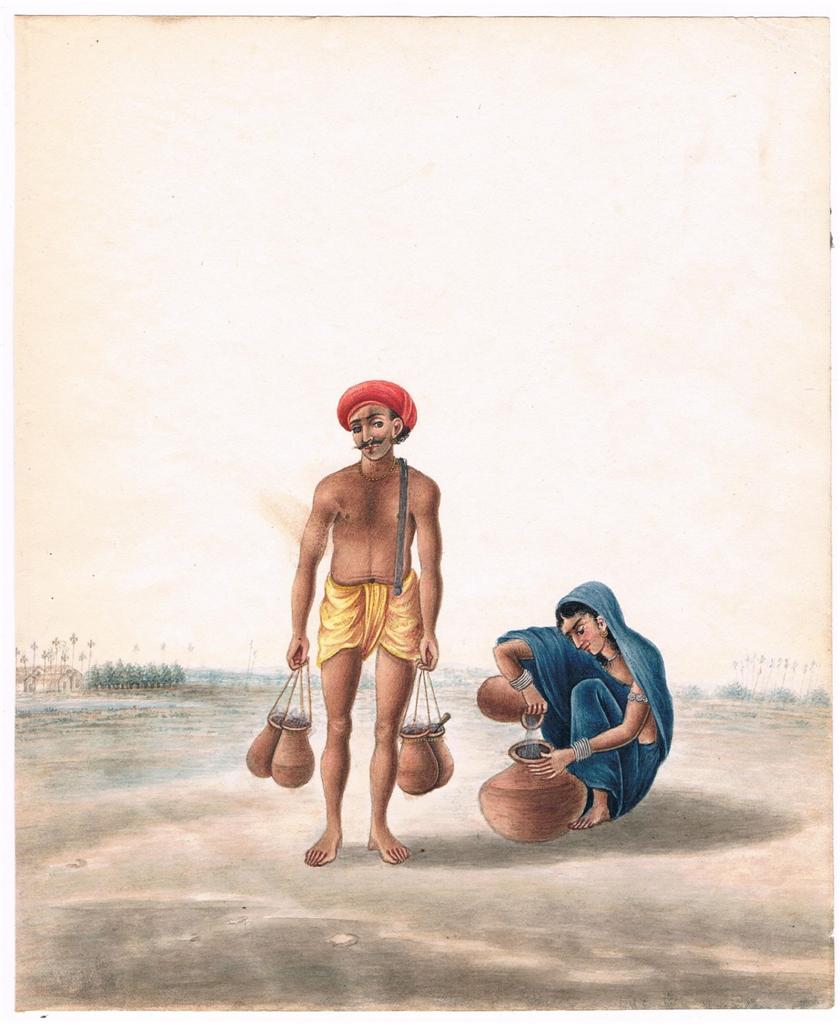
Image

Origins: From Mughal Courts to Patna’s Streets

Patna Kalam emerged in the 18th century, during the decline of the Mughal Empire. As royal patronage weakened in Delhi and other courts, many miniature painters migrated eastward in search of new opportunities. Some eventually settled in Patna (then known as Azimabad), which was a thriving commercial and cultural center.

While deeply influenced by Mughal miniature techniques  fine brushwork, attention to detail, and delicate line rendering  Patna Kalam developed its own identity.

Instead of focusing on emperors and court scenes, artists turned their gaze toward:

  • Local traders

  • Artisans at work

  • Festivals and rituals

  • Soldiers, musicians, dancers

  • Bazaar life and domestic scenes

In many ways, Patna Kalam became a visual archive of 18th–19th century urban India.
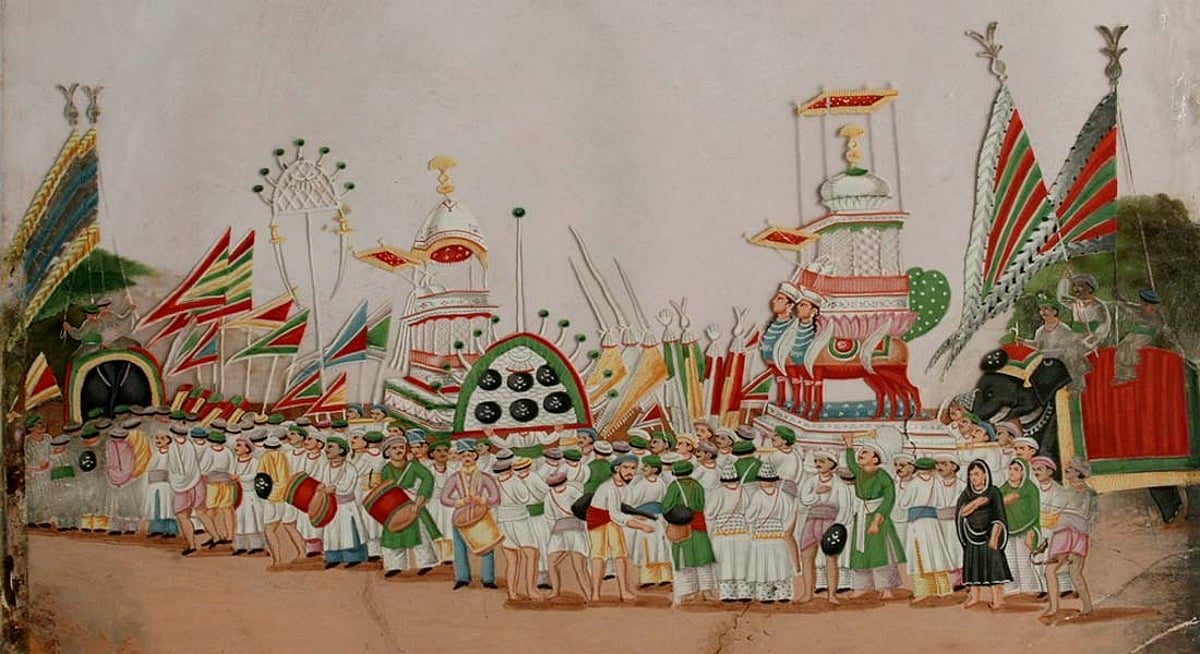
Image

A Distinctive Style

Patna Kalam stood apart for several reasons:

1. Everyday Realism

Unlike the stylized romanticism of many court schools, Patna artists captured realism. Their subjects were ordinary people engaged in daily activities — spinning yarn, selling vegetables, preparing food, playing instruments.

2. Transparent Watercolours

Artists used subtle washes of transparent watercolour, often on paper or mica. The palette was restrained earthy tones, soft reds, muted blues, and delicate shading.

3. Minimal Backgrounds

Unlike Mughal miniatures filled with elaborate settings, Patna Kalam often featured sparse or no backgrounds, allowing the human subject to dominate the composition.

4. Fine Draftsmanship

The linework was meticulous. Even the folds of clothing and textures of tools were rendered with exceptional precision.

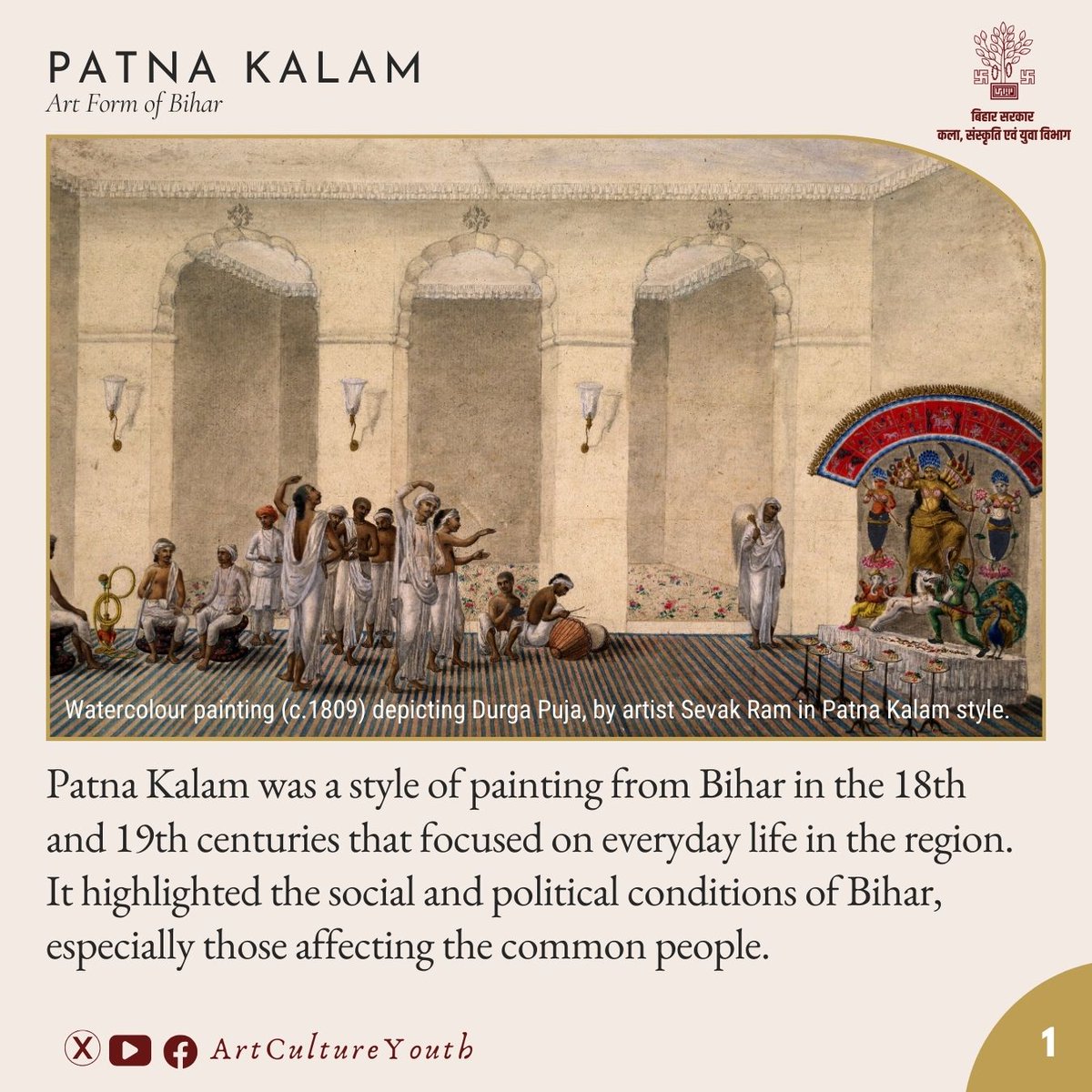
Image

Image


Prominent Practitioners

While many names have faded from public memory, several artists are historically associated with the Patna School.

Sevaks Ram (c. 1770–1830)

Often regarded as one of the earliest and most important exponents of Patna Kalam, Sevaks Ram helped shape the school’s distinct identity. His works demonstrate strong Mughal training blended with observational realism.

Hulas Lal

Known for detailed depictions of everyday occupations, Hulas Lal contributed to the documentation of social life in Patna and surrounding regions.

Ishwari Prasad Verma (1887–1949)

One of the later practitioners of the tradition, Ishwari Prasad Verma is often considered among the last significant artists of the Patna School. His work bridged tradition and modernity, but by his time, patronage had significantly declined.

Many Patna Kalam artists also produced works for British patrons during the colonial period, contributing to what later came to be described as the “Company School” style — though Patna Kalam retained its own regional sensibility.

The Colonial Shift and Gradual Decline

During British rule, some Patna artists adapted their skills to serve colonial officials who desired ethnographic documentation — paintings of local castes, trades, and customs.

While this provided temporary patronage, it also altered the direction of the art form. Over time:

  • Photography replaced painted documentation.

  • Royal and elite patronage diminished.

  • Modern art movements shifted aesthetic priorities.

By the early 20th century, Patna Kalam had largely faded as a living tradition.

Why Patna Kalam Matters Today

Patna Kalam is not merely a regional style — it is a social document.

It tells us:

  • What people wore

  • What they traded

  • How they worked

  • How festivals were celebrated

  • What everyday India looked like two centuries ago

In an era where visual storytelling is dominated by digital media, this school reminds us that documentation through art has deep roots in Indian history.

For artists from Bihar and beyond, Patna Kalam represents:

  • A bridge between Mughal precision and local narrative

  • An early form of social realism in Indian art

  • A reminder that heritage includes the lives of ordinary people

Revival: A Necessary Conversation

Recent discussions and interviews around reviving Patna Kalam are both timely and urgent.

Revival cannot be symbolic. It requires:

  • Archival research

  • Institutional support

  • Workshops and training

  • Inclusion in art curricula

  • Exhibitions and collector awareness

Most importantly, it requires artists willing to study and practice the technique deeply — not as imitation, but as continuation.

A Personal Reflection

As someone deeply engaged with traditional art forms, I feel that every regional style carries a responsibility. Whether it is Madhubani, Kalamkari, or Patna Kalam — these are not static museum objects.

They are living languages.

If we stop speaking them, they fade.

If we practice them, teach them, and reinterpret them thoughtfully, they evolve.

Patna Kalam once recorded the heartbeat of a city.
Perhaps it is time to let it record our present — again.

#patnakalam #indianart #heritageconservation #biharart #artrevival

My Experience at Craft Bazaar, Chennai – Showcasing Madhubani Art

I had the wonderful opportunity to participate in the Craft Bazaar organised by the Craft Council of India at the Mother Teresa Women’s Comp...