My TEDx Talk

Showing posts with label A Hundred Hands. Show all posts

Monday, August 04, 2025

Back to Exhibiting - The Monsoon Collective at Forum South Bengaluru


Returning to the Exhibition Space After a Long Gap

After a long gap, stepping back into an exhibition space felt both nostalgic and energising. From 1st to 3rd August 2025, I had the privilege of participating in The Monsoon Collective, beautifully curated by A Hundred Hands, at Forum South Bengaluru, JP Nagar.


Incredible 3 Days

The Monsoon Collective at Forum South Bengaluru was a resounding success as it truly felt like the entire community of art lovers in South Bangalore had gathered under one roof!


Grateful to A Hundred Hands for curating such a soulful handmade experience, and to everyone who stopped by, appreciated, and supported my work. The love for my Madhubani collection, especially the newly launched tote bags and wall plates, was overwhelming and deeply encouraging.


These conversations, smiles, and stories are what keep me going.

An Event That Drew the Art Lovers of South Bangalore

Walking into the venue on Day One, I was greeted by the soft hum of conversations, the earthy smell of handmade crafts, and that unique energy that only comes when creators and appreciators share the same space. It was heartwarming to see so many art lovers from across South Bangalore — it truly felt like the entire art-loving community had gathered under one roof.


Showcasing My Madhubani Art Collection

I displayed a vibrant range of Madhubani art — from wearable art pieces to intricate paintings — each one telling a story rooted in tradition.

Launching New Product Categories at The Monsoon Collective

For the first time, I introduced two new product lines:

  • Hand-Painted Madhubani Tote Bags — blending functionality with traditional Indian folk art.

  • Decorative Wall Plates — bringing heritage designs into modern home décor.


Overwhelming Response from Visitors

The appreciation was overwhelming. Many visitors shared that they had never seen Madhubani interpreted in such a contemporary way before. People took the time to learn about the symbolism behind each motif, the painstaking hours of work, and the heritage each piece carried.

Connecting with Art Lovers and Collectors

The event was filled with meaningful conversations — from students discovering Madhubani for the first time to seasoned collectors reminiscing about their own pieces. I found myself sharing stories of Kohbar motifs, the symbolism of peacocks, fish, and lotuses, and my personal journey as a self-taught artist.

A Celebration of Handmade and Heritage

Over three days, The Monsoon Collective proved to be more than just a marketplace — it was a celebration of craftsmanship, tradition, and the bond between artists and their audiences.


Heartfelt Gratitude

As I packed up at the end of the event, my heart was full. I carried back not just sales, but also the encouragement and warmth that will fuel my next creations. Thank you to everyone who came by, and to A Hundred Hands for curating this soulful handmade experience.


Wednesday, February 19, 2025

Reflections on the Festival of Handmade - The Spring Edit

Reflections on the Festival of Handmade – The Spring Edit

As I reflect on the past few days, I cannot help but feel immense gratitude for the incredible experience I had at the Festival of Handmade—The Spring Edit at NIFT Bangalore. From February 12th to 16th, 2025, the event was inspiring, with an overwhelming response from art lovers, students, and passionate supporters of handmade crafts.


The weekend saw a record crowd, and I was delighted to meet so many of my followers and students who took the time to visit, engage, and share their love for Madhubani art. Their enthusiasm reaffirmed why I do what I do—bringing stories to life through colors, lines, and intricate patterns.


One of the most heartwarming aspects of this event was the presence of many elderly visitors. Many of them appreciated my work and shared their experiences and perspectives on art, culture, and heritage. Seeing them connect deeply with my paintings was touching, and to my delight, several took pieces home with them. Their encouragement and thoughtful conversations left a lasting impression on me.


Another fascinating aspect of this event was the interaction with NIFT students, who were exploring various traditional art forms, including Madhubani, as part of their research project. It was truly enriching to share my artistic journey, insights into the evolution of Madhubani, and the nuances of preserving its authenticity while adapting it to contemporary designs. Their curiosity and eagerness to learn about folk art were refreshing, and I loved being part of their learning process.


Another highlight was a visit by a group of students who were introduced to Madhubani art. 


Every event is a learning experience, and this one was no different. The vibrant energy, the shared love for handmade art, and the meaningful exchanges made this edition of the Festival of Handmade truly special. A huge thank you to A Hundred Hands for curating such an excellent platform where artisans and craft lovers can come together to celebrate creativity.

To everyone who visited, supported, and took a piece of Madhubani art home with them—thank you! Your love keeps this tradition alive, and I can't wait to create more for you.

Until the next time, keep celebrating handmade! ✨


Monday, January 14, 2019

Tales of water told in art

Tales of water told in art

Madhubani art

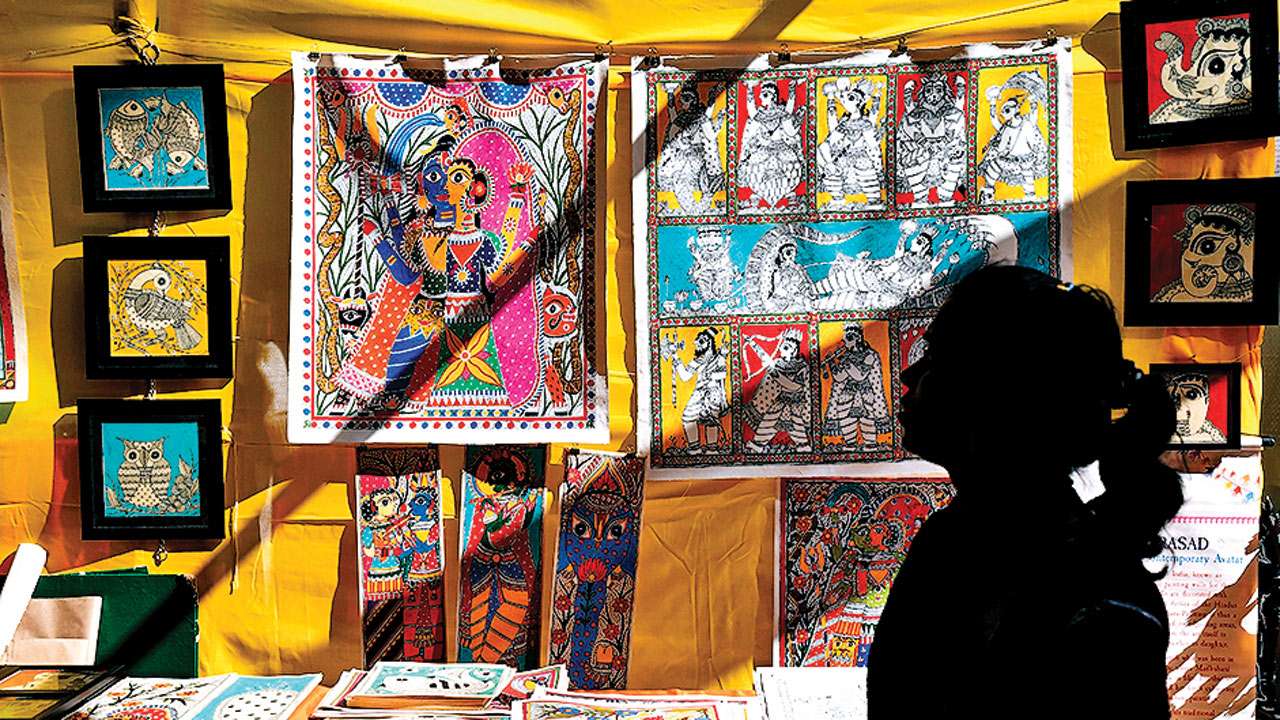
 A visitor looks at the artwork at Madhubani art at the exhibition - Salman Ansari, DNA

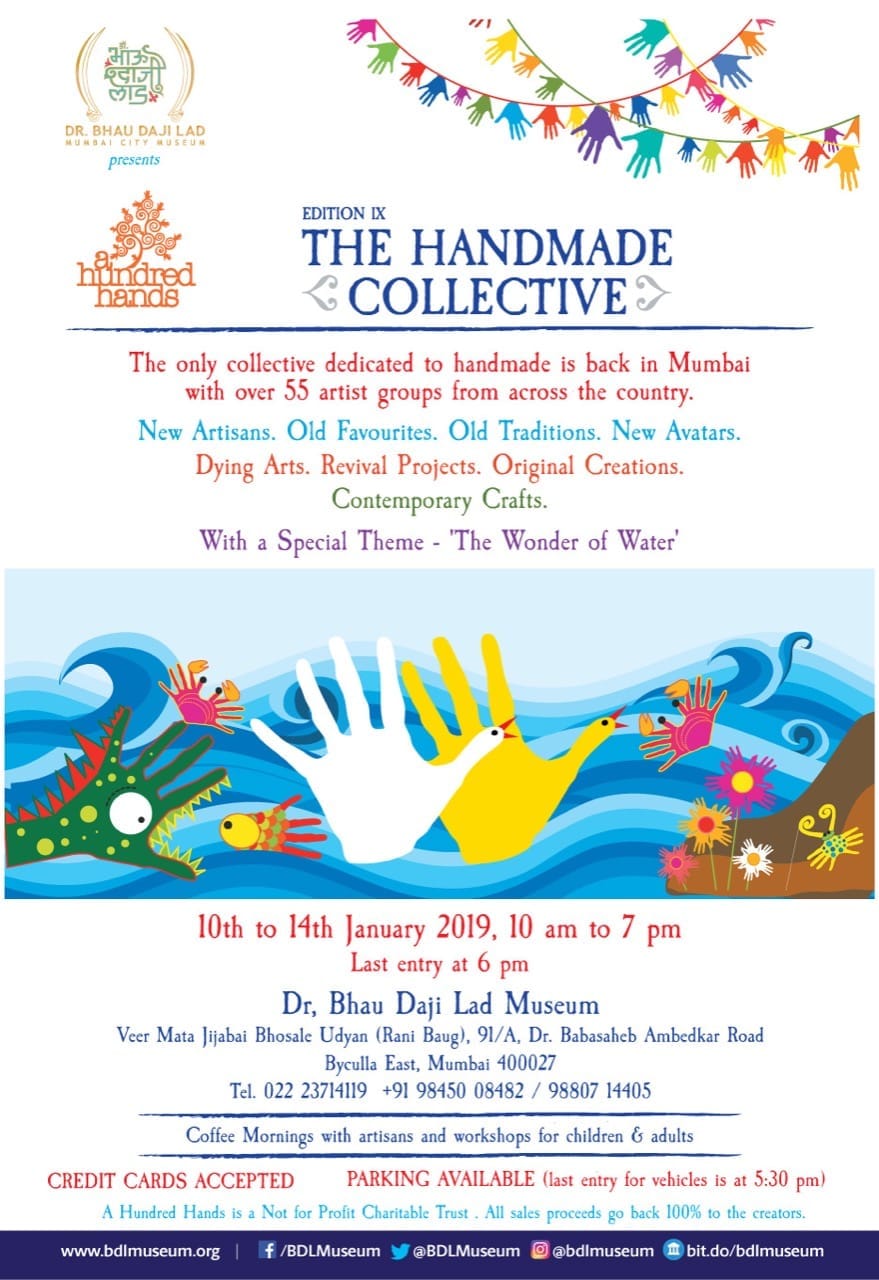
Dotted fish swim across a bandhni dupatta, aquatic plants grace block-printed stoles, aquamarine gems glint in the sunlight and brighten the colourful cluster of India cork handicrafts. The third edition of Annual Handmade Collective by A Hundred Hands at the Bhau Daji Lad Museum (ongoing till January 14) followed the theme is water. Where preachy talks and didactic monologue may fail, some of the artists and artisans participating the exhibit have shown both through the use of motifs and the way in which they have cut down on water usage in their work.
Shubham Chhipa of Gopal Handprints, who hails from Jaipur, says that conserving water is even more important to him than achieving the perfect white in his handblock prints. “We recycle the water we use to wash the clothes after they have been dyed,” he explains. “Usually, the same dye is used twice a week and we keep the water aside to use for both washes along with leftover dye.”
Hailing from the outskirts of Bhuj, Sulaiman Khatri has also taken to using dyes that set easily as opposed to ones that require more washes for his bandhini brand Ababil. In Bengal, Rubi and Arup Rakshit of MG Gramodyog Sewa Sansthan, supply their muslin and jamdani weavers with rain-fed, short staple desi cotton instead of the water and fertiliser-intensive BT cotton. “Cloth from the latter has traces of chemicals, even after many washes. Desi cotton requires less water during the weaving process,” explains Arup.
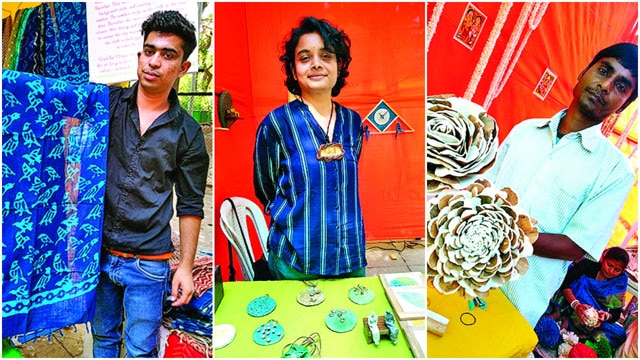
 (Shubham Chhipa of Gopal Hand Prints; Preeti from Aranya Earthcraftssholapith artist Gobindo Haldar)
While Khatri, Chhipa and Arup work with cloth, Preeti, who helms Aaranya Earthcrafts works with papier mache. A green pendant holds bronze lotus flowers and leaves, another in deep aquamarine looks like a lotus stem dotted with tiny bronze mushrooms. As her inspiration comes from nature, it was easy for her to rustle up artefacts on the theme of water. “We use the same water for soaking the paper, then the gond and then the mitti, as opposed to throwing it away each time,” explains the artist. “This takes more time, but the sequence of paper-gond-mitti remains the same.”
With just a bit of improvisation, the artistes show that saving water is not just possible but easy.

A Symbiotic Art

One of the more colourful shops at the exhibition is Gobindo Haldar’s sholapith shop. Hailing from a village on the outskirts of Kolkata, Haldar’s one of the few remaining exponents of art to use this spongey water plant growing in marshy land in Orissa, Assam and Bengal. Thanks to less intricate and more durable substitutes like plastic flowers and thermocole, Haldar finds his business endangered. “Once the wedding season used to see booming for shola artists since we supplied most of the decor. However, today, we struggle through the winter and wait for puja seasons,” laments Haldar, who has come to Mumbai with his colourful shola artwork with borrowed money and high hopes for buyers and wholesale tie-ups.

Sunday, July 26, 2015

Monsoon Collective by A Hundred Hands at NIFT, BLR

I would be displaying some of her select Madhubani work at this event from August 6 to 9, 2015 at NIFT campus at HSR Layout, Bangalore. The event is being organised by A Hundred Hands, a non-profit trust based in Bangalore, India.  Its vision is to create a world that celebrates the pleasure of handmade crafts in homes and daily lives.   

Learning, Networking, and New Perspectives at MSME Sparks 2026

Last week, I had the opportunity to attend the MSME Sparks 2026 Grand Finale in Bengalurua melting pot of founders, investors, and ecosystem...