From a dream to preserve Madhubani art to a thriving artistic community, our journey has been incredible. Check out my latest video where I delve into our origins and the passion that drives us.
Showing posts with label madhubani. Show all posts
Showing posts with label madhubani. Show all posts
Sunday, June 23, 2024


Sunday, May 31, 2020
Tuesday, November 05, 2019
Handmade Collective 2109
My initiation into giving a traditional art Madhubani) a contemporary flavour started with A Hundred Hands. It all started with the first Mango collective by A Hundred Hands in 2013 when I tried to create something new with the theme. I made paintings in katchni style with a background with mango colours. The appreciation that I received from those paintings made me experiment with themes each year and playing with colors that gradually became my signature style. Hence I take the themes decided each year for the handmade collective seriously as I know it will lead to something new in my collection.
Do visit: At the 10th Handmade Collective. Bangalore-20th-24th November at jayamahal palace hotel Coimbatore-29th November to 1st December at Whispering Stones Kochi 5th-'8th December at David Hall #


Do visit: At the 10th Handmade Collective. Bangalore-20th-24th November at jayamahal palace hotel Coimbatore-29th November to 1st December at Whispering Stones Kochi 5th-'8th December at David Hall #


Saturday, August 17, 2019
My Signature Collection of Ganesha at the House of Eka in Bangalore
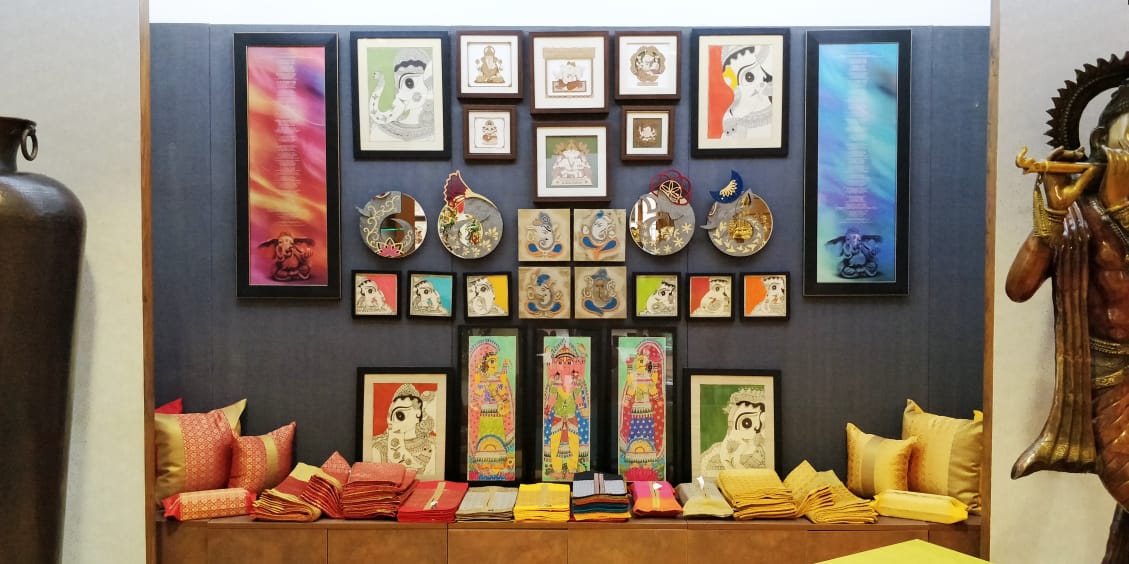
. Eka celebrates its 20th year of Ganesha festival from 16th August to 2nd September 2019
https://www.houseofeka.com/
Monday, September 24, 2018
Royal Grace on the cover of book on Mithila Painting
My mithila work "Royal Grace" created in 2011 is on the cover of the book by Shankar Kumar Lal, a PhD scholar from Kashi Vidyapeeth.The book was unveiled in Vidyapati Bhavan, Patna, by the Bihar Governor Mr. Lalji Tandon, Deputy Chief Minister Mr. Sushil Kumar Modi.


Wednesday, September 05, 2018


Wednesday, February 14, 2018
Madhubani Workshop in Delhi
Would be conducting a Mithila workshop in Delhi on 25 February at Cafe De Art

About the Workshop:
· Details and history of Madhubani/Mithila Paintings
· KOHBAR (wall painting done during weddings)
· Significance of Kohbar motifs
· Various styles of Madhubani paintings
· How to make Madhubani painting on your own.

Tuesday, June 27, 2017


Sunday, August 28, 2016
Donated my work to CRY

"In a country of more than a billion, a large number of #children suffer from high #malnutrition rates, poor sanitation and other issues including #childlabour. According to statistics, #India is home to the largest number of children in the world and it has 20 per cent of the 0-4 years’ child population of the world. Being a #mother, I understand the needs of a child. I always wanted to help the underprivileged children in some way but did not know how to do it. But then I got in touch with #CRY for one of their noble initiatives of sourcing art from prestigious artists. I readily agreed and wanted to do my part by contributing through my artistic skills so I thought of creating some work for CRY. I hold CRY in high esteem for long and am proud to have been associated with the organization. I'll be more than happy to participate in similar initiatives for CRY in future," Vidushini Prasad, Artist
You too can #doyourbit at www.cry.org
#madhubani #art #painting #motherandchild
Thursday, August 11, 2016
Dedicated to World Elephant Day 2016

Pl post, if you have created any Madhubani with Elephant as the theme and support the cause.
Background: On August 12, 2012, the inaugural World Elephant Day was launched to bring attention to the urgent plight of Asian and African elephants. The elephant is loved, revered and respected by people and cultures around the world, yet we balance on the brink of seeing the last of this magnificent creature.
The escalation of poaching, habitat loss, human-elephant conflict and mistreatment in captivity are just some of the threats to both African and Asian elephants. Working towards better protection for wild elephants, improving enforcement policies to prevent the illegal poaching and trade of ivory, conserving elephant habitats, better treatment for captive elephants and, when appropriate, reintroducing captive elephants into natural, protected sanctuaries are the goals that numerous elephant conservation organizations are focusing on around the world.
World Elephant Day asks you to experience elephants in non-exploitive and sustainable environments where elephants can thrive under care and protection. On World Elephant Day, August 12, express your concern, share your knowledge and support solutions for the better care of captive and wild elephants alike.
Support World Elephant Day so that we can continue to be a collective voice speaking out on behalf of elephants!
Sunday, February 28, 2016
Madhubani@Fabindia
Fabindia at Phoenix City, Bangalore has decorated one of their sections with a Madhubani created by me


Monday, November 02, 2015
As politicians wrangle for votes, Mithilanchal’s heritage wallows in neglect
Sonali Das | TNN | Nov 2, 2015, 11.12 PM IST
 Women painting a silk saree at a village in Madhubani.
MADHUBANI: Politicians in Bihar have given a miss to the rich cultural heritage of the Mithilanchal region over decades, though the state has basked in the glory of Madhubani paintings, acclaimed globally.
Successive governments in Bihar have also ignored the heritage of renowned Bengali writer Bibhuti Bhushan Mukhopadhyaya, whose native house — visited by famous shehnai player Bismillah Khan and classical singer Ram Chatur Mallick in the heart of Darbhanga town — now lies in ruins. A number of Bengali films were based on Mukhopadhyaya's works and his book "Kushi Pranganer Chithi'', translated as `Kushi Pranganak Chithi' in Maithili, was also included in the curriculum of Bangla literature in schools and colleges in Bihar and West Bengal.
At village Ranti in Madhubani district, the 'jantra' painted on the wall of the drawing room of national award winner Godavari Dutt is mesmerizing. Vibrant and colourful, the painting, depicting man's connection with Nature, reflects the rich culture of the region which had grabbed global attention decades ago.
"It took me several months to make this painting," said the octogenarian, who now, due to her failing health, finds it difficult to walk. Dutt has travelled with her paintings to several countries, including France and Japan. "This painting is our cultural heritage and is done in every household in this village and Jeetwarpur, where many famed painters, including Padma Shri Sundari Devi, have lived.
She rued that though the paintings had done very well in the national and international markets, painters couldn't reap benefits as the government failed to streamline their marketing. "Middlemen are minting money by selling our work nationally and internationally while we are paid a pittance for our hard work," she said, adding the government should at least fix rates for sale of the paintings.
Women painting a silk saree at a village in Madhubani.
MADHUBANI: Politicians in Bihar have given a miss to the rich cultural heritage of the Mithilanchal region over decades, though the state has basked in the glory of Madhubani paintings, acclaimed globally.
Successive governments in Bihar have also ignored the heritage of renowned Bengali writer Bibhuti Bhushan Mukhopadhyaya, whose native house — visited by famous shehnai player Bismillah Khan and classical singer Ram Chatur Mallick in the heart of Darbhanga town — now lies in ruins. A number of Bengali films were based on Mukhopadhyaya's works and his book "Kushi Pranganer Chithi'', translated as `Kushi Pranganak Chithi' in Maithili, was also included in the curriculum of Bangla literature in schools and colleges in Bihar and West Bengal.
Successive governments in Bihar have also ignored the heritage of renowned Bengali writer Bibhuti Bhushan Mukhopadhyaya, whose native house — visited by famous shehnai player Bismillah Khan and classical singer Ram Chatur Mallick in the heart of Darbhanga town — now lies in ruins. A number of Bengali films were based on Mukhopadhyaya's works and his book "Kushi Pranganer Chithi'', translated as `Kushi Pranganak Chithi' in Maithili, was also included in the curriculum of Bangla literature in schools and colleges in Bihar and West Bengal.
At village Ranti in Madhubani district, the 'jantra' painted on the wall of the drawing room of national award winner Godavari Dutt is mesmerizing. Vibrant and colourful, the painting, depicting man's connection with Nature, reflects the rich culture of the region which had grabbed global attention decades ago.
"It took me several months to make this painting," said the octogenarian, who now, due to her failing health, finds it difficult to walk. Dutt has travelled with her paintings to several countries, including France and Japan. "This painting is our cultural heritage and is done in every household in this village and Jeetwarpur, where many famed painters, including Padma Shri Sundari Devi, have lived.
"It took me several months to make this painting," said the octogenarian, who now, due to her failing health, finds it difficult to walk. Dutt has travelled with her paintings to several countries, including France and Japan. "This painting is our cultural heritage and is done in every household in this village and Jeetwarpur, where many famed painters, including Padma Shri Sundari Devi, have lived.
She rued that though the paintings had done very well in the national and international markets, painters couldn't reap benefits as the government failed to streamline their marketing. "Middlemen are minting money by selling our work nationally and internationally while we are paid a pittance for our hard work," she said, adding the government should at least fix rates for sale of the paintings.
Sunday, October 04, 2015
The Tribal Art Paradox
The appreciation of folk art as 'art' is just skin deep, says Gargi Gupta of DNA as she discusses the destruction of a Madhubani painter's mural
Mural by Madhubani artist Ganga Devi that was painted over
The recent destruction at Delhi's Crafts Museum of a large mural by Ganga Devi, a pioneering Madhubani painter, strikes at the root of the paradoxes surrounding tribal art today.
On the one hand is the lack of appreciation — the bureaucrats' disregard for a large, important work by an internationally-acclaimed artist, a Padma Shri awardee no less. Ganga Devi's mural was, according to Jyotindra Jain, the former Crafts Museum director, who first flagged its destruction on Facebook, "the only example of a complete iconographic rendering of Mithila's kohbar ghar". (Kohbar ghar is the nuptial chamber which would traditionally be covered with paintings depicting auspicious and fertility symbols. Madhubani paintings even now depict motifs ofkohbar ghar murals.)
Besides, its tragic history — it was one of the last works she executed while undergoing chemotherapy for cancer — added to its importance. According to Jain, "Ganga Devi used to weep due to the painful treatment and had painted the chamber to occupy herself with something she found creatively engaging." Undoubtedly, had it been a modernist master — Husain or Souza, for instance, instead of Ganga Devi — a work with such a poignant back story would never have been painted over in a thoughtless "modernisation" drive.
There has been a growing market for Madhubani and other forms of tribal art in recent years but it's mostly for small works, churned out in bulk by artists who've renounced the painstaking, traditional methods for modern, quicker methods so they can keep prices at the Rs1,000-2,000 levels.
Prices, even in auction (art auction house Saffronart has had a dedicated sale of folk and tribal art since 2012) where large works by senior, important artists come up for sale, have remained low, barring a few exceptions like Gond artist Jangarh Singh Shyam. At the recent Saffronart "folk and tribal art auction", for instance, a work by Baua Devi, an early exponent of Madhubani painting like Ganga Devi, sold for Rs 42,900, less than its estimated high price of Rs 45,000.
But over and above these, the Ganga Devi episode reveals the more fundamental paradox of Indian tribal art. Traditionally, these paintings were part of the artists' daily lives — they decorated their walls with them, re-touched them when they became faint and when they had completely worn out, the walls would be repainted and covered again with art.
This changed in the 1960s, when under the likes of arts administrator Pupul Jayakar, artists J. Swaminathan and Bhaskar Kulkarni, and American anthropologists Raymond Owens and David Szanton, those like Ganga Devi were persuaded to switch to paper. That gave their art-works longer shelf-life and mobility, and brought prosperity as well as new identity as artists.
But as the destruction of the Crafts Museum mural shows, the appreciation of our folk artheritage as "art" runs only skin deep — until the next renovation when the officials think nothing of destroying another lot of art-works instead of finding ways to preserve them.
Thursday, September 10, 2015
Please Sign: Restore Late Ganga Devi's Madhubani Murals at National Crafts Museum in Delhi
According to a report in Times of India, Titled, Crafts museum ‘renovation’ wipes out famed Madhubani murals, A painted chamber which had beautiful ceiling-to-floor murals by renowned Madhubani artist, the late Ganga Devi, has been demolished as part of a new modernization plan at the National Crafts Museum, sparking an outcry from art lovers in the Capital. The room was painted by Ganga Devi over six months in the 1990s when she was undergoing chemotherapy and had to stay at the Crafts Museum. She distracted herself from the pain by devoting her energy to creating a Mithila style kohbar ghar, the room where marriages are solemnized and consummated in Bihar. She died a year later. Jyotindra Jain, who was then director of the Crafts Museum and saw the artist at work, said he was shocked by the destruction. "Ganga Devi gave new direction to Madhubani painting. She was a legend and her contribution was recognized with a Padma Shri. The chamber was a unique monument in the history of contemporary folk and tribal arts of India.
Here is the link to the petition, pl sign and lend your support.
Wednesday, September 09, 2015

Monday, September 07, 2015
Khadi panel move to benefit Mithila painting artists
By C S Jha ‘Azad’
Madhubani: The initiative taken by the Khadi and Village Industries Commission (KVIC), ministry of micro, small and medium enterprises (MSME), Government of India, is likely to revive the almost 'dead khadi' industry in the state.
The move is likely to benefit the artists of Mithila painting in Madhubani district mostly. Hundreds of such artists of the district, majority of them women, would be freed from the clutches of 'middlemen' by this move and get proper remuneration of their products. To implement the scheme in a phase-wise manner, the All India Khadi Gramodyoga Board, the nodal agency for the project, has shortlisted Madhubani district in the first phase followed by Darbhanga and Sitamarhi districts in the second phase.
As per the plan, a cluster of artists would be formed and a total of Rs10 crore would be spent on them during a span of five years. About 1,000 artists from the district will form the cluster, said KVIC PRO S C Jha here.
He said an extensive survey of villages of the district was conducted by Bihar State Khadi Board director R S Pandey, between August 7-8 last and he alongwith Vijay Kumar Singh, deputy development officer, State Khadi Board, is contacting artists from Ranti, Jitwarpur, Mangarauni, Pilakhwar and other villages of Mithilanchal since September 3 last with a view to persuading them to join the programme.
Several private agencies of Madhubani, Darbhanga, Sitamarhi and Bhagalpur would provide silk and other raw materials directly to these artists and the finished products with Mithila paintings on them would then be sent to the Board's Delhi-based sales outlet in Connaught place for marketing, said the PRO.
Jha said 100 pieces of silk saris and 100 pieces of dress materials have already been made available to about 50 selected artists of different villages for making Mithila paintings on them.
These items would be put on display at an 'Exhibition-cum-Sale' at Khadi Gramodyoga Bhawan, Connaught Place, New Delhi, on the occasion of Gandhi Jayanti on October 2.
Friday, August 28, 2015
Some of my select paintings are available on India Arts Collector
http://www.indianartcollectors.com/artists/vidushini
- Best FriendsPainting by VidushiniLot No: 143800 | Acrylic & Ink on Paper
15 X 22 Inches11,310 | $170 - Indian BrideFolk Art by VidushiniLot No: 143799 | Acrylic & Ink on Paper
15 X 22 Inches11,310 | $170 - The Holy Union - ArdhanareshwarFolk Art by VidushiniLot No: 143798 | Acrylic & Ink on Canvas
26 X 31 Inches29,410 | $450


Sunday, August 23, 2015


Tuesday, August 18, 2015
My Madhubani Painting Titled "Celebration of Life" on IHC Lok Sangeet Sammelan Invite
Madhubani painting titled 'Celebration of Life' done by me has been chosen as the overall theme visual for the 'Celebrating the rivers of India', Organised by India Habitat Centre as a part of IHC Lok Sangeet Sammelan to be staged at Stein Auditorium in Delhi on the 22nd and 23rd of August. Sudha Raghuraman from Delhi, Gulzar Ahmad Ganie from Kashmir, Nozrul Islam from Assam, Rituparna Banerjee from Bengal &Basanti Devi from Kumaun are the folk musicians from different parts of the country who will perform in this year’s Lok Sangeet Sammelan singing ballads of Ganga, Brahmaputra, Narmada, Krishna, Kaveri and other rivers of India.
Those in Delhi should attend this event. Details below.


Saturday, August 15, 2015


Subscribe to:
Posts (Atom)
Learning, Networking, and New Perspectives at MSME Sparks 2026
Last week, I had the opportunity to attend the MSME Sparks 2026 Grand Finale in Bengalurua melting pot of founders, investors, and ecosystem...
